Beyond Cardio: How the Right Exercise Prescription Can Directly Improve Erectile Function and Sexual Stamina
For years, the conversation around exercise and men's sexual health has been dominated by a single, somewhat reductive talking point: cardiovascular fitness improves blood flow, and better blood flow means better erections. While that connection is real and well-documented, reducing the relationship between physical training and sexual function to a simple equation does a disservice to the complexity of the male body.
The truth is that the type of exercise you perform, the muscle groups you engage, the hormones your training stimulates or suppresses, and the recovery time you allow between sessions all interact in ways that meaningfully influence erectile quality, libido, and endurance. Understanding those interactions allows men to train not just for aesthetics or athletic performance, but for a fuller, more functional life — including what happens behind closed doors.
The Pelvic Floor: The Most Overlooked Muscle Group in Men's Fitness
Ask most American men to identify their pelvic floor, and you will likely be met with a blank stare. This group of muscles — which runs like a hammock from the pubic bone to the tailbone — is rarely discussed in mainstream fitness culture, yet it plays a central role in erectile rigidity, ejaculatory control, and urinary function.
Research published in BJU International found that pelvic floor rehabilitation exercises were as effective as pharmaceutical intervention for certain categories of erectile dysfunction, particularly in men whose condition was linked to venous leakage rather than arterial insufficiency. The mechanism is straightforward: the ischiocavernosus and bulbocavernosus muscles, both components of the pelvic floor, contract during erection to restrict venous outflow and maintain penile rigidity. When these muscles are weak or poorly coordinated, maintaining a firm erection becomes physiologically more difficult.
Kegel exercises — long associated almost exclusively with women's postpartum recovery — are equally applicable to men. A basic protocol involves identifying the muscles used to stop urination midstream, contracting them for three to five seconds, releasing fully, and repeating for two to three sets of ten repetitions daily. Consistency over eight to twelve weeks typically produces measurable improvements in erectile quality and ejaculatory control.
Resistance Training and the Hormonal Equation
Compound strength movements — squats, deadlifts, bench press, and overhead press — do more than build muscle mass. Performed at moderate to high intensity, they trigger a transient spike in testosterone and growth hormone, both of which support libido and erectile function over time.
The relationship between resistance training volume and testosterone is, however, not linear. Moderate training loads tend to produce favorable hormonal responses, while excessive volume or insufficient recovery can tip the scales in the opposite direction, elevating cortisol and suppressing testosterone. This is the overtraining dynamic that undermines the sexual health of men who train compulsively without adequate rest.
For men seeking to optimize hormonal output, a protocol of three to four resistance sessions per week — emphasizing large muscle groups and compound movements — appears to strike the most beneficial balance. Training legs in particular, given the mass of musculature involved, generates a more pronounced hormonal stimulus than isolated upper-body work alone.
Flexibility and Mobility: The Underrated Dimensions of Sexual Performance
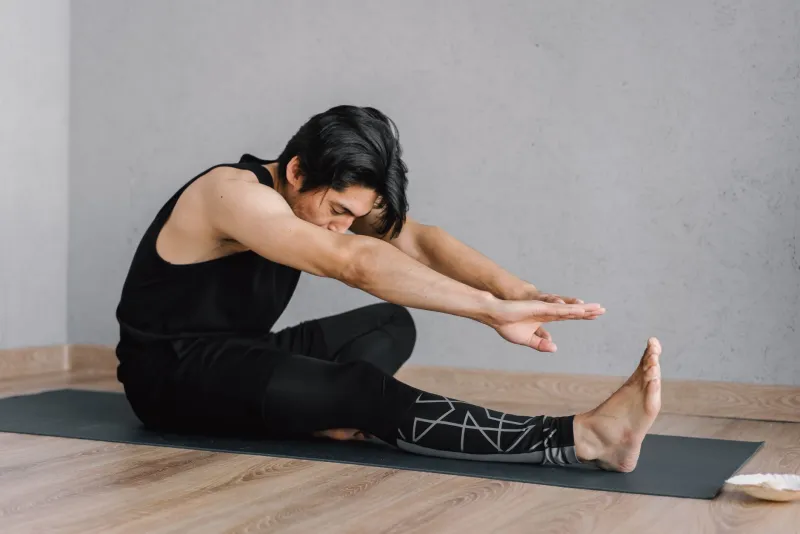
Sexual activity places the body in positions that demand a meaningful degree of hip mobility, lumbar flexibility, and core stability. Men who spend the majority of their waking hours seated — a reality for much of the American workforce — frequently develop tight hip flexors, restricted thoracic rotation, and reduced hamstring flexibility that translate directly into physical limitations and discomfort during intimacy.
A targeted mobility practice does not require a yoga studio membership or elaborate equipment. Fifteen to twenty minutes of daily hip flexor stretching, pigeon pose variations, and thoracic spine mobilization exercises can meaningfully expand range of motion over weeks. Beyond the mechanical benefits, flexibility work activates the parasympathetic nervous system — the branch of the autonomic nervous system associated with relaxation and arousal — which supports the physiological state necessary for sexual response.
Aerobic Exercise: Frequency and Intensity Matter More Than Duration
Cardiovascular training remains foundational, but the specifics matter considerably. Prolonged, low-intensity steady-state cardio — the kind performed on a treadmill at a moderate pace for forty-five minutes — produces modest benefits for vascular health but does relatively little for hormonal optimization.
High-intensity interval training (HIIT), by contrast, has been shown in multiple studies to produce superior improvements in endothelial function — the health of the inner lining of blood vessels — in shorter time frames. Since erectile function depends fundamentally on the dilation of penile arteries in response to nitric oxide signaling, endothelial health is a direct determinant of erectile capacity. Three sessions of HIIT per week, each lasting twenty to thirty minutes, appear sufficient to generate meaningful vascular benefits without the cortisol burden associated with excessive aerobic volume.
Cycling warrants a specific note of caution. Extended time in the saddle on a narrow bicycle seat can compress the perineal region, temporarily reducing blood flow to penile tissue. Men who cycle frequently and experience any numbness or erectile changes should consider ergonomic saddle adjustments or reduce session duration.
Recovery as an Active Component of Sexual Health
Recovery is not the absence of training — it is a distinct and essential phase in which the body consolidates hormonal adaptations, repairs muscle tissue, and restores nervous system balance. Men who treat rest days as wasted days often undermine the very gains they are working toward, including those related to sexual health.
Quality sleep, in particular, is non-negotiable. The majority of daily testosterone production occurs during deep sleep cycles, and chronic sleep restriction — a common feature of American professional life — measurably suppresses testosterone levels within days. Prioritizing seven to nine hours of sleep per night is among the highest-yield interventions available to men concerned about sexual function.
Active recovery practices such as walking, swimming at low intensity, and foam rolling support circulation and reduce systemic inflammation without taxing the endocrine system. Incorporating one or two such sessions per week alongside more demanding training days creates a rhythm that sustains both athletic performance and hormonal health.
Putting It Together: A Framework Built for Real Life
The practical takeaway from the research is that no single form of exercise holds the key to optimal sexual function. What matters is balance — a routine that combines compound resistance training, interval-based cardiovascular work, deliberate pelvic floor conditioning, and consistent flexibility practice, all supported by adequate recovery.
For men already managing erectile dysfunction with prescribed medications, this kind of structured fitness approach functions as a powerful complement rather than a replacement. At TadacipRx, we recognize that effective sexual health management is rarely a single-lever problem. Medication can address the immediate physiological barrier, but lifestyle — including how you train — shapes the broader environment in which your body either thrives or struggles.
If you have questions about how your current treatment plan interacts with lifestyle factors, a licensed healthcare provider can help you build a comprehensive strategy. Convenient, discreet consultations are available through telehealth platforms that connect you with qualified clinicians from your own home — no waiting room required.